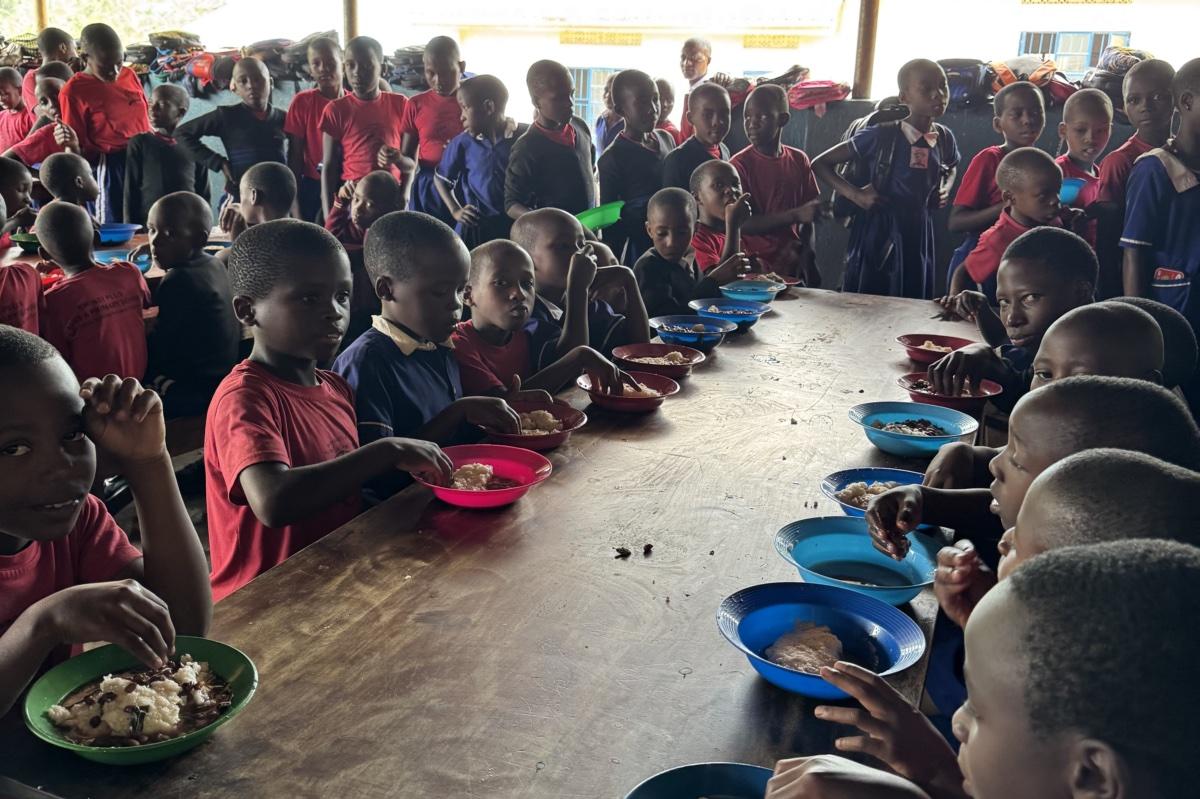
Feeding 400 Children,
Sustainably
A school nutrition program at Bwindi Plus Nursery and Primary School in rural Uganda, designed so the school covers more of it each year.
The Gap We're Closing
400 primary students at Bwindi Plus currently receive a basic daily meal of posho (maize flour) and beans. It keeps hunger at bay, but falls short on the protein, healthy fats, and micronutrients children need to grow and learn.
The school is already feeding the kids. Posho, beans, groundnuts, occasional meat, daily greens. What's missing is the supplementation layer: daily protein from silver fish, daily avocados for healthy fats, weekly eggs, fortified breakfast porridge.
The model we built doesn't replace the school's meal program. It extends it, and is structured so the school covers more of the extension each year.
Buy Land. Free Up Budget. Add Nutrition.
For a one-time $14,667 investment in Year 1, we launch a full nutrition supplementation program designed so the school covers a significant share on its own from Year 2 onward.
The Farm
1 acre of farmland where the school grows its own beans and posho, replacing what they currently buy from the local market. Land upkeep is a fraction of the savings.
Supplemental Food
Protein, vitamins, and fats the school's existing meal doesn't provide, purchased weekly at the local Kihihi market and delivered to the school kitchen.
StrongHer × Bwindi Plus
Our women's empowerment project, StrongHer, operates in the same community. By converting 25 of StrongHer's chickens to laying hens, the women produce ~100 eggs per week and sell them directly to the school at market rate.
StrongHer Women
100 laying hens producing eggs for sale at market rate.
Bwindi Plus School
400 kids receiving weekly eggs as part of their supplemental nutrition.
The women get
A guaranteed customer: recurring revenue they can build a business around.
The school gets
A reliable local supplier for a key part of the kids' nutrition plan.
What the Children Eat
The base meal is what the school already provides from its own budget. The supplementation layer is what our grant adds, and what the school progressively covers itself from Year 2 onward.
Base Meal
Provided by the school's existing budget
| Food | Quantity / Day | Frequency | Nutritional Role |
|---|---|---|---|
| Posho (maize flour) | 2.5 sacks | Daily | Calories, energy |
| Beans | 25 kg | Daily | Protein, fiber |
| Groundnuts | ~0.7 kg | Daily | Healthy fats, zinc |
| Meat | ~56 kg/term | ~1× / month | Animal protein |
| Greens | As available | Daily | Vitamins, minerals |
| Sugar | 6 bags/term | Daily (porridge) | Energy |
| Salt | 3 cartons/term | Daily | Sodium |
Supplementation Layer
Funded by our grant in Year 1, shared with the school from Year 2 onward
| Food | Qty / Day | Frequency | Nutritional Role | Annual Cost |
|---|---|---|---|---|
| Silver fish | 2 kg | Daily (270 days) | Protein, calcium, iron | $1,543 |
| Avocados | 100 | Daily (270 days) | Healthy fats, potassium | $3,857 |
| Dodo / sukuma | 3 heads | Daily (270 days) | Iron, calcium, vit A & C | $463 |
| Eggs | 13 trays | 1× / week (36 wks) | Complete protein, B12, zinc | $1,737 |
| Millet flour | 6 bags/term | Daily (breakfast) | Energy, B vitamins | $411 |
| Sorghum | 6 bags/term | Daily (breakfast) | Energy, iron, fiber | $171 |
| Supplementation total | $8,182 | |||
Year 1 vs. Year 2+
The school's budget stays flat. They don't spend a dollar more. The farm just makes their existing dollars go further, freeing room for better nutrition. Our grant drops 65% from Year 1 to Year 2.
Launch
Sustained
From Year 2 onward, the farm replaces $4,629 of posho and beans the school used to buy at market. After $771 in land upkeep, the school redirects $3,857 net savings toward eggs, dodo, millet, sorghum, and land operation, all items our grant covered in Year 1. That drops our ongoing commitment to less than $13 per child per year.
Three Reasons This Holds Up
Built to last
After Year 1, the school redirects its own farm savings to cover supplemental items. Our ongoing role is manageable and sustainable, not a perpetual subsidy.
Every dollar stays in the community
Food is sourced from Kihihi market. Eggs come from StrongHer women next door. The farmland is managed by the school. Nothing leaks out of the local economy.
It feeds the whole child
Daily protein from silver fish, daily avocados for healthy fats, weekly eggs, daily greens, and fortified porridge, all layered on top of the posho-and-beans meal the school already provides.
From Supplementation to Self-Sufficiency
Phase 1 proved the model on 1 acre. Phase 2 expands it into three programs donors can fund separately: more farmland, a goat program for meat, and a dairy program for milk.
Farmland
Each acre replaces $3,500 a year in market-purchased food. Pays for itself in under two years. The savings continue forever.
Goat Program
10 goats plus 1 acre of grazing land. Goats breed fast and the herd grows itself, turning a one-time gift into a permanent meat supply for the school.
Dairy Program
3 cows plus 1 acre of grazing land. Fresh milk once a week for every child, and calves that grow the herd.
With Phase 2 in place, the school grows or raises nearly all of its own food. Our grant role winds down, and the nutrition program becomes permanently self-funded.
The Footnotes
- Students served~400 primary-level children
- School year3 terms, ~90 days each (270 days/year)
- LocationBwindi Plus Nursery and Primary School, P.O. Box 62, Kabale, Uganda
- Exchange rate3,500 UGX = $1 USD
- Verified spendFrom Term III 2025 expenditure records (stamped 20 Sep 2025)
- GroundnutsCovered separately by the school's existing farmland
Feed the
Next Term
Phase 1 is funded. The farm and the first year of supplementation are in motion. Year 2 is what we're building next.
100% of donations go directly to the work in Uganda.