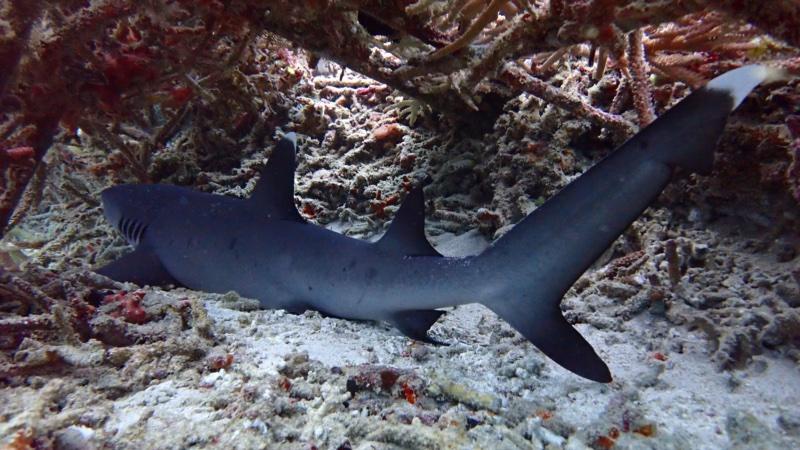
How a Rubble Field Becomes a Living Reef
Coral restoration is methodical, slow, and measured. Here's how the program we fund takes a degraded patch of seafloor and brings it back, and why each step matters.
Three Techniques, One Reef
Restoring a coral reef takes more than planting corals. The seafloor has to be stable. The corals need a healthy source. And the new growth has to be watched, year after year.
The Methods
Stop the rubble from spreading
When the reef is broken into rubble, currents keep the pieces moving. Young corals can't get a foothold and die. Stabilization always comes first.
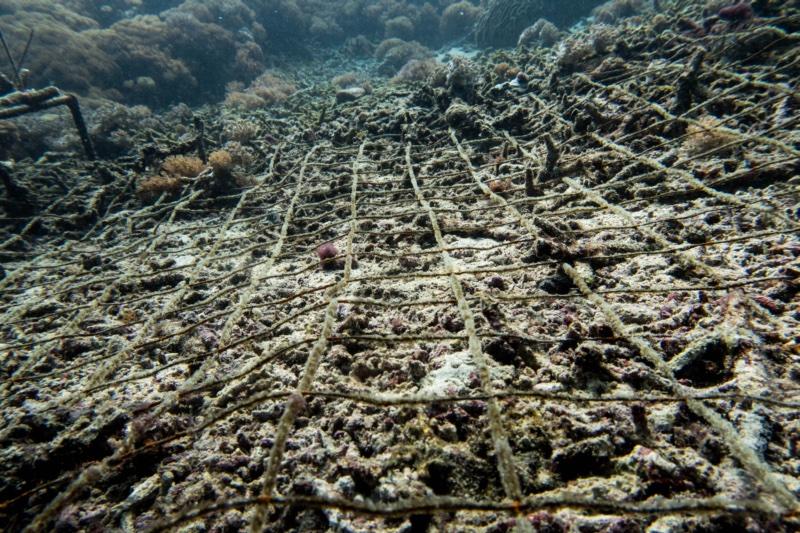
Wire mesh laid across the seafloor traps rubble long enough for sponges and coralline algae to bind it together naturally
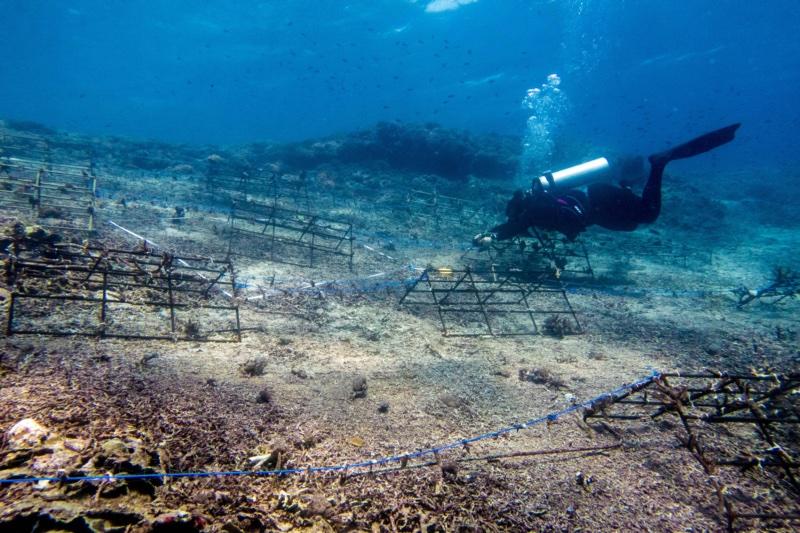
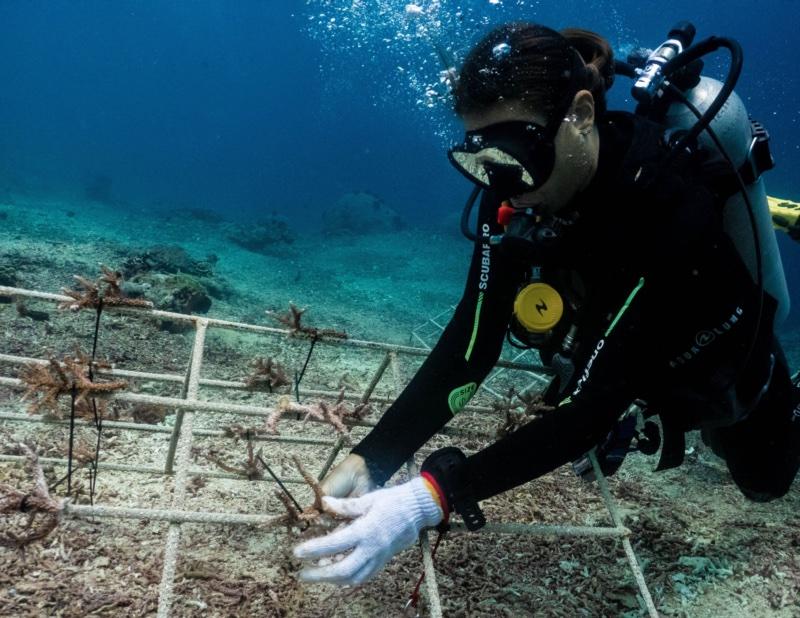
Modular rebar frames sit on the rubble field, slowing erosion and giving young corals a stable platform
Coral ropes strung between frames let young colonies grow off the seafloor while terracing the reef
Without stable substrate, no transplant survives. This is the foundation
Grow healthy stock, then plant
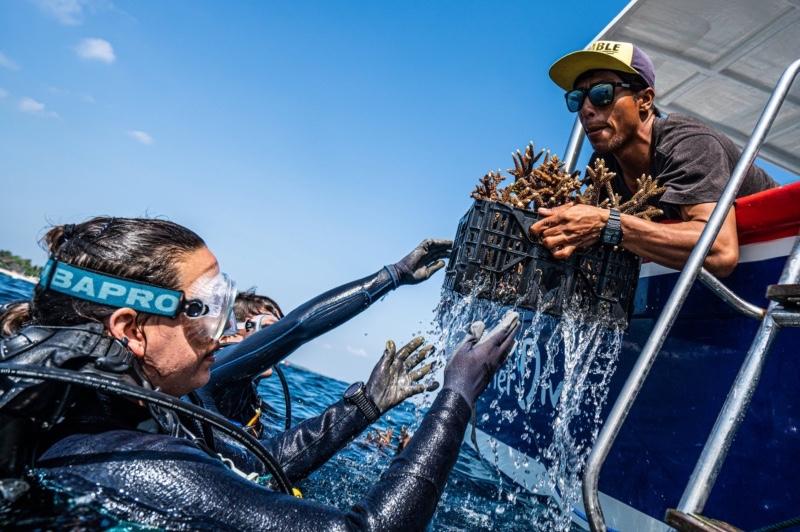
Transplants come from a floating coral nursery on-site, never harvested from neighbouring reef. The nursery is the upstream piece of the system.
Healthy parent corals are kept in a floating mid-water nursery away from sediment and pressure
Fragments are taken from the nursery, not from the wild reef, so no donor site is depleted
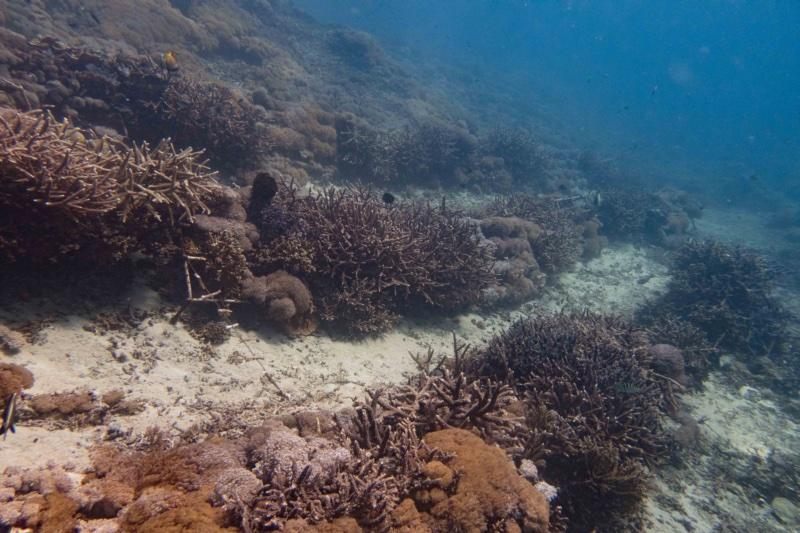
Multiple species are planted together to mimic a natural reef community
Single-parent micro-fragmentation of three coral species is being studied at the pilot site
Watch what happens, for years
Restoration without monitoring is just gardening. Every transplant is tracked. Every fish surveyed. Every change documented.
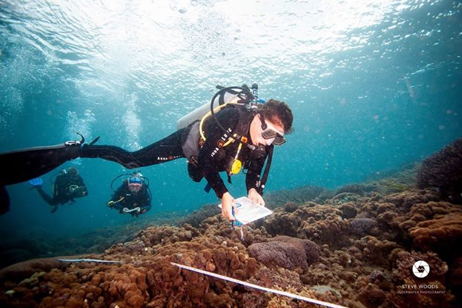
Transplants are supervised for at least one year after planting, tracking survival, growth, and secondary settlement
Fish, benthic, and invertebrate surveys measure whether the ecosystem is functioning, not just whether corals are alive
Photogrammetry creates 3D maps of the site so changes are measurable, not just visible
Loose fragments are reattached on every dive. The work doesn't stop after planting
What Restoration Actually Delivers
Bringing a reef back isn't just about coral cover. The work creates layered benefits that extend through the ecosystem and into the communities that depend on it.
Reverses Rubble Expansion
Untreated rubble fields don't shrink. They grow, smothering nearby healthy reef. Stabilization stops the bleed and protects what's still alive.
Restores Habitat & Topography
A complex reef structure shelters thousands of species. Modular frames and growing corals rebuild the three-dimensional habitat fish, invertebrates, and megafauna depend on.
Supports Fisheries & Tourism
Healthy reef means more fish for local fisheries and more reason for divers and snorkelers to visit. Restoration is conservation that pays back into the local economy.
Builds Local Conservation Capacity
Indonesian student scholarships and divemaster training mean every restored reef also produces trained marine biologists and dive professionals from the surrounding communities.
The 4-Phase Restoration Project
The Nusa Islands Restoration Project didn't start with planting. It started with years of monitoring, then a pilot study, then a multi-year plan. Here's how the work has unfolded since 2011.
Site Monitoring
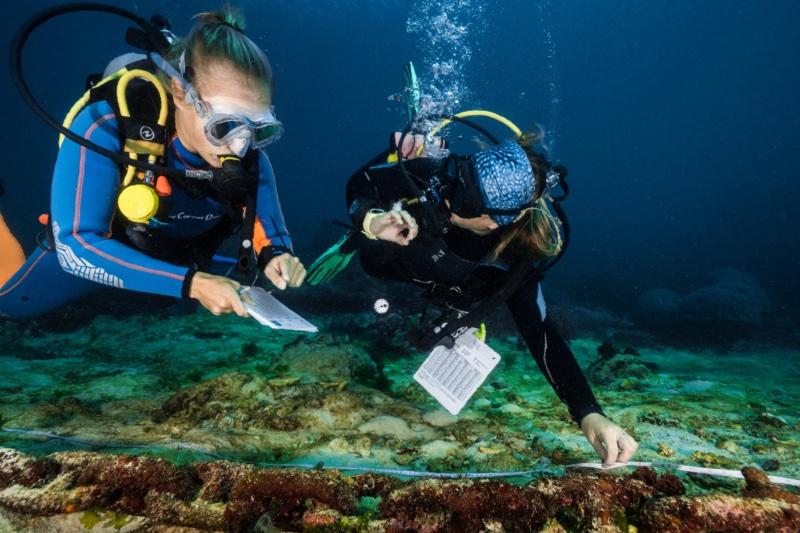
Before any restoration began, the team spent years monitoring rubble areas along Nusa Penida's northern coast, measuring fish, benthic communities, and natural recruitment to confirm that these reefs were not recovering on their own. Long-term monitoring continues to this day.
- Confirmed rubble fields were spreading, not recovering
- Mapped degraded sites and prioritized for restoration suitability
Pilot Study at Sental Reef
The team chose a degraded patch of reef at Sental Divesite to test whether restoration was even possible at this site. The two-part approach, physical stabilization with modular frames plus biological supplementation through coral transplants, worked. Studies on multi-species transplants and micro-fragmentation continue at the pilot site today.
- Proved modular frames + transplantation works in Nusa Penida's currents
- Established the techniques used at every site since
Restoration Plan & Site Design
Every restoration site needs a written plan: the current state, the target reef community, and the recovery trajectory between them. The team chose modular coated metal frames for substrate stabilization and built a floating coral nursery so transplants would come from healthy on-site stock, never harvested from surrounding reef.
- Defined target endpoints and measurable recovery indicators
- Built a floating nursery to grow transplant stock on-site
Implementation, Monitoring & Community
The active phase. Frames are installed, corals transplanted, and the site monitored continuously by a team of biologists and rotating cohorts of interns. The restoration footprint has expanded along the northern coast, and a second project at Mangrove Reef on Nusa Lembongan opened in 2024.
- 150,000+ corals planted and counting
- Six days a week, all year long. Restoration as routine, not event
Where the Science Lives
Restoration claims should be measurable. The work we fund is published, both as peer-reviewed papers and through scholarship programs that put Indonesian students on the science.
Peer-Reviewed Restoration Science
Findings from the Nusa Penida site have been published in peer-reviewed journals, including work on early ecosystem function recovery that looks past coral survival rates to whether the ecosystem itself is starting to function again.
Student Research at the Site
Indonesian university students we sponsor have published their own work, including a study of competition between an invasive sponge and restoration corals, the kind of finding that shapes how the next decade of restoration is done.
See the Reef
We're Restoring
You've seen how it works. Now meet the reef itself: its biodiversity, its threats, and the marine life that depends on it.
100% of donations go directly to coral restoration work in Indonesia.